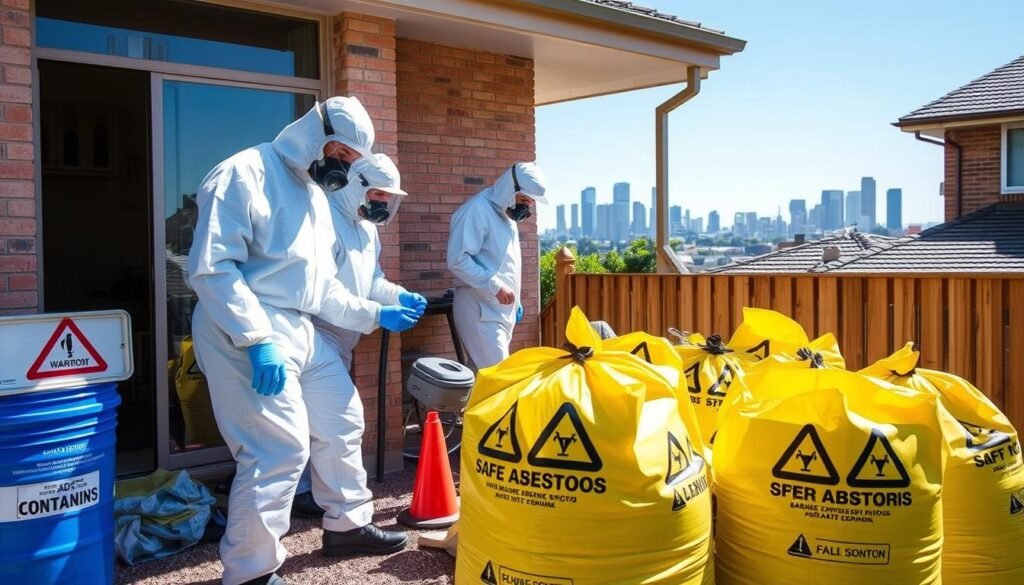
If your neighbour is removing asbestos without notifying you in Sydney, close your doors and windows, move people and pets away from the boundary, avoid touching any dust or debris, document what you can safely observe, and report unsafe work to SafeWork NSW or your local council.
Do not walk onto the property, confront workers in the removal area, collect material yourself, or attempt to clean suspected asbestos dust.
A lack of notice does not automatically prove that the work is illegal. However, visible dust, broken asbestos sheets, dry cutting, power tools, uncovered waste or debris crossing your boundary should be treated seriously.
This guide explains what Sydney residents can do, which authority to contact and how a licensed asbestos removalist in Sydney may help if your property has been affected.
Important: This article provides general information, not legal or medical advice. Where you believe fibres or fragments have entered your property, seek site-specific advice before cleaning the area.
Quick Action Checklist
Use this checklist when you first notice suspected asbestos work next door:
- Go indoors and keep children and pets away.
- Close windows, external doors and vents facing the work.
- Turn off systems drawing outdoor air from that side where practical.
- Do not sweep, vacuum, hose or pick up debris.
- Take photos or videos only from a safe position on your property.
- Write down the address, time, weather and what you observed.
- Call SafeWork NSW on 13 10 50 if work appears unsafe.
- Contact your local council if the concern involves a residential property.
- Call 000 where there is an immediate threat to life or public safety.
SafeWork NSW directs workplace and worker-related asbestos concerns to its inspectors, while concerns about asbestos in a home can also be raised with the relevant local council.
Is My Neighbour Legally Required to Notify Me?
The answer depends on the type of project, its approval conditions and the asbestos work being performed.
SafeWork NSW must be notified at least five calendar days before licensed asbestos removal involving:
- more than 10 square metres of non-friable or bonded asbestos; or
- any amount of friable asbestos.
Emergency removal has a separate process and may proceed sooner when a sudden event creates an immediate exposure risk or disrupts an essential service.
That regulatory notification is made to SafeWork NSW. It is not the same as personally notifying every neighbour.
Separate neighbour-notification duties may arise under planning approvals, demolition conditions, complying development requirements or the asbestos removal control plan. NSW planning guidance says neighbours must be notified before demolition carried out as complying development.
Therefore, the fact that you did not receive a letter does not, by itself, confirm a breach. The more important question is whether the asbestos is being removed safely and in accordance with the applicable licence, approval and site controls.
What Warning Signs Suggest Unsafe Asbestos Removal?
You do not need to identify asbestos with certainty before reporting a genuine concern. In fact, asbestos cannot be reliably confirmed just by looking at a material.
Still, some work practices deserve immediate attention.
Visible dust is leaving the property
Bonded asbestos is less likely to release fibres while it remains intact. The risk increases when it is broken, drilled, sawn, sanded or crushed.
NSW Health explains that asbestos may release fibres when materials are damaged, including through cutting, drilling or water blasting.
Dust clouds drifting toward neighbouring homes are not a normal sign of controlled asbestos removal.
Sheets are being smashed or dropped
Competent removal generally aims to keep asbestos-containing sheets intact. Throwing panels from a roof, deliberately breaking them or crushing them into a skip can increase the chance of fibre release.
Workers are using grinders, saws or high-pressure water
Power tools can create fine dust. High-pressure water can damage asbestos cement surfaces and spread contamination.
Waste is not wrapped or contained
Asbestos waste should not be left loose in an open skip or transported uncovered. NSW guidance states that asbestos waste must be taken to a facility licensed to accept it.
Debris has landed in your yard
Small grey fragments, broken corrugated material or pieces resembling fibre-cement sheeting should not be handled. Keep people away and arrange professional assessment.
There are no barriers or warning signs
A lack of visible signage does not always prove illegal work. However, licensed removal should involve controls suited to the risk, such as restricted access, containment, protective equipment and decontamination procedures.
What Should I Do Immediately?
1. Move away from the boundary
Bring children and pets indoors. Avoid balconies, gardens, driveways or side paths close to the work.
Do not stand near the fence to film workers. Your first aim is to reduce potential exposure, not gather perfect evidence.
2. Close the house
Close doors and windows on the affected side. Where practical, switch off exhaust fans or ventilation systems that may pull outdoor air inside.
You do not need to seal the entire building with tape. Take calm, sensible steps until an authority or qualified professional assesses the situation.
3. Do not clean suspected contamination
Do not:
- sweep it;
- use a household vacuum;
- leaf-blow it;
- hose it into drains;
- place it in a normal rubbish bin; or
- carry it back to the neighbour.
Ordinary vacuum cleaners can recirculate fine particles. Sweeping and dry brushing can also disturb settled material.
4. Record factual observations
From your property or a public place, record:
- the address;
- date and time;
- type of work;
- whether materials were broken;
- whether power tools were used;
- whether dust was visible;
- wind direction;
- vehicle registration details;
- company or licence information displayed; and
- whether fragments entered your property.
Keep your notes factual. Instead of writing, “They are illegally removing asbestos,” write, “Two workers broke grey corrugated sheets and placed loose pieces into an uncovered skip.”
This gives inspectors clearer information to assess.
5. Report urgent concerns
NSW Government guidance says concerns about asbestos removal and unsafe building sites should be referred to SafeWork NSW. Councils can also investigate unauthorised building work or breaches of development consent and may issue compliance orders, stop-work orders or fines.
SafeWork NSW can be contacted on 13 10 50.
For residential asbestos issues, contact the compliance or environmental health team at your local council. Sydney includes many separate council areas, so report the issue to the council responsible for the property address.
Should I Speak to My Neighbour First?
A calm conversation may resolve a simple communication issue, but only approach your neighbour when it is safe.
You might say:
“Hi, I noticed building material being removed near our boundary. Could you please confirm whether it has been tested for asbestos and whether a licensed removalist is managing the work?”
Ask whether they can provide:
- the removalist’s name;
- the asbestos removal licence number;
- the proposed work period;
- details of containment measures; and
- contact information for the site supervisor.
Do not enter the removal zone or argue with workers. If dust is actively being produced or material is crossing the boundary, contact the authorities first.
Can My Neighbour Remove Asbestos Themselves?
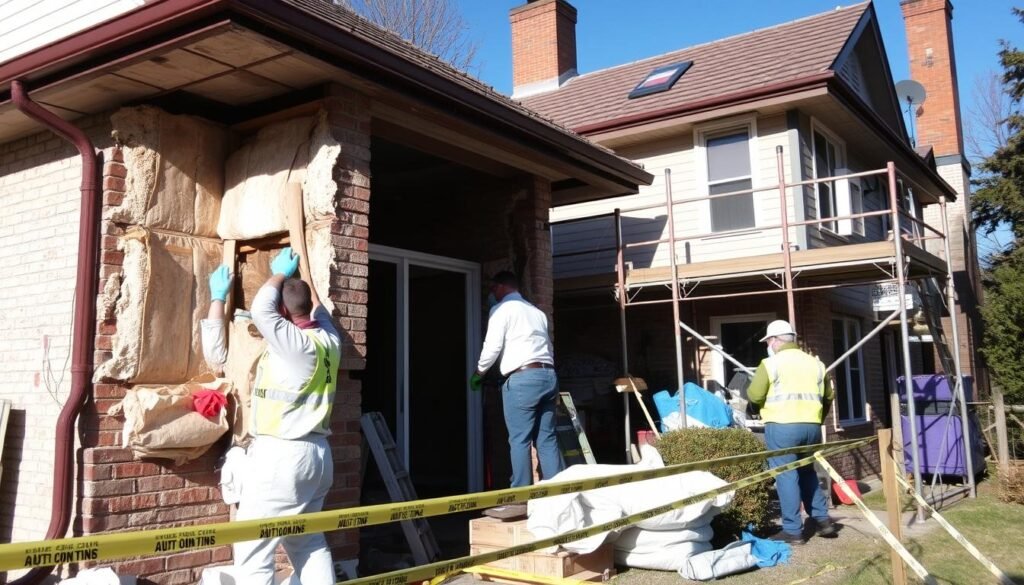
In NSW, a homeowner may be permitted to remove a limited amount of non-friable asbestos from their own property. However, government guidance strongly recommends using a licensed professional because removal, decontamination and disposal carry health risks.
Licensed removal is required for more than 10 square metres of non-friable asbestos. Any amount of friable asbestos requires appropriately licensed removal work. SafeWork NSW’s notification rules apply to licensed jobs involving more than 10 square metres of non-friable material or any friable material.
What is bonded asbestos?
Bonded, or non-friable, asbestos has fibres fixed within a solid material such as cement. Common examples include older wall sheets, eaves, fences and corrugated roofing.
It may remain relatively stable while sealed and intact. It becomes more concerning when weathered, drilled, broken or cut.
What is friable asbestos?
Friable asbestos can be crumbled or reduced to powder by hand pressure when dry. Examples may include old insulation, pipe lagging and severely damaged asbestos products.
Friable material releases fibres more easily and requires stricter controls.
Who Should I Contact in Sydney?
SafeWork NSW
Contact SafeWork NSW when:
- workers or tradespeople are involved;
- you suspect an unlicensed removalist;
- unsafe work practices are occurring;
- dust is escaping the work area;
- required containment appears absent; or
- licensed work may not have been notified.
Phone: 13 10 50
Your local council
Contact the local council when:
- the work is taking place at a home;
- you suspect unauthorised demolition;
- work may breach development consent;
- waste or debris is affecting neighbouring land;
- you cannot identify the contractor; or
- you need the council to inspect a residential site.
Local councils have asbestos-management responsibilities that include providing advice, assessing development risks and responding to asbestos concerns within their local government area.
NSW Environment Protection Authority
Contact the NSW Environment Protection Authority when asbestos has been illegally dumped or waste has been transported or disposed of unlawfully.
The NSW asbestos reporting service lists 1800 272 378 and the NSW EPA Environment Line on 131 555 for reports of illegally dumped asbestos.
Emergency services
Call 000 when there is an immediate danger to life, a fire, structural collapse or another emergency requiring urgent attendance.
What Happens After I Make a Report?
An authority may ask for:
- the site address;
- photographs;
- times and dates;
- descriptions of the material;
- details of workers or vehicles;
- whether dust crossed the boundary; and
- whether work is continuing.
The council may check the development approval and conditions. SafeWork NSW may assess whether licensing, notification and work controls apply.
Inspectors, not neighbours, determine whether the law has been breached.
Avoid repeatedly approaching the site while the matter is being reviewed. Continue to keep your household away from any suspected debris.
What If Asbestos Debris Has Entered My Property?
Do not handle it.
Create a simple exclusion area by keeping people away. Avoid mowing, gardening or moving outdoor furniture around the suspected material.
Take photographs without touching the fragments. Then contact your council, SafeWork NSW or a licensed asbestos professional for advice.
A qualified assessor or removalist may recommend:
- inspecting the affected area;
- sampling suspected material;
- wet removal of visible fragments;
- specialised cleaning;
- soil assessment where fragments entered garden beds;
- air monitoring in higher-risk situations; and
- a clearance inspection after remediation.
Do not assume that every nearby removal has contaminated your property. Equally, do not dismiss visible fragments or dust without professional advice.
Should I Get My Home Tested?
Testing may be sensible when:
- visible fragments landed on your property;
- dust entered through open windows;
- the work involved heavily broken or friable material;
- your outdoor play area or garden was affected;
- work continued for several days without controls; or
- an authority recommends assessment.
A sample should be collected by a competent person and analysed by an accredited laboratory. Avoid taking your own sample because breaking or scraping material can create additional risk.
Testing does not always mean sampling indoor air. The right approach depends on the material, location, condition and likely pathway of exposure.
Do I Need to Leave My Home?
Not automatically.
Asbestos exposure risk depends on whether fibres were released, how close you were, how long the event continued and whether material entered your home.
Asbestos in good condition generally presents a low risk when it is not being disturbed. The main health concern is breathing airborne fibres released from damaged material.
You may consider temporarily leaving the immediate area when:
- visible dust is drifting toward the house;
- friable material appears to be disturbed;
- doors or windows were open beside the work;
- emergency services or inspectors advise you to leave; or
- your household includes someone who cannot be kept away from the affected area.
For personal medical concerns, speak with your GP. Do not rely on an asbestos removalist to provide medical advice.
Can I Claim Cleaning or Remediation Costs?
Responsibility depends on the evidence and circumstances.
Keep copies of:
- photographs and videos;
- council or SafeWork reference numbers;
- inspection reports;
- laboratory results;
- cleaning and remediation quotations;
- invoices;
- written communication with the neighbour; and
- any clearance documentation.
Do not pay for unnecessary work solely out of fear. First establish whether contamination is likely and what remediation is reasonably required.
Where property damage or significant costs are involved, consider obtaining legal advice before entering a dispute. NSW Government guidance also identifies community justice services and legal advice as possible pathways for neighbouring-development disputes.
How X-Asbestos Removalist Sydney Can Help
X-Asbestos Removalist Sydney can help property owners assess suspected asbestos material and plan safe removal where asbestos debris has affected their property.
Depending on the circumstances, assistance may include:
- inspecting suspected bonded asbestos;
- arranging laboratory testing;
- assessing visible fragments;
- preparing a safe removal plan;
- removing and wrapping contaminated material;
- coordinating lawful waste disposal;
- cleaning the affected work area; and
- arranging clearance documentation where required.
The team services Sydney homes, strata properties, commercial premises and renovation sites.
When contacting an asbestos removalist Sydney residents should provide photos, the property suburb, the material’s approximate location and a brief explanation of what occurred. Do not move the material to obtain a better photo.
For planned work, ask for a written scope covering removal, containment, disposal charges and clearance requirements. A cheap asbestos removalist Sydney quote may not represent good value if lawful disposal, protection measures or documentation are excluded.
What Does Asbestos Removal Cost in Sydney?
The asbestos removal cost depends on:
- the type of asbestos;
- quantity;
- condition;
- access;
- height;
- containment requirements;
- laboratory testing;
- waste volume;
- disposal fees; and
- whether soil or indoor surfaces are affected.
A small number of fragments may require an inspection and minimum call-out rather than square-metre pricing. Wider contamination may require testing, specialised cleaning and independent clearance.
Government guidance confirms that cost varies according to the age, condition and volume of asbestos-containing material.
Ask for a written quote from a licensed asbestos removalist Sydney property owners can verify. The quote should state whether testing, transport, disposal, cleaning and clearance are included.
Be cautious of advertisements promising “free asbestos removalist Sydney” services. A new NSW household asbestos-disposal trial was announced in July 2026, but a disposal initiative should not be confused with free professional removal, testing or remediation at every Sydney property. Eligibility and service details must be checked through official NSW channels.
Common Mistakes to Avoid
Confronting workers inside the removal zone
This may increase your exposure and create conflict. Report the situation from a safe place.
Picking up a fragment as evidence
A photograph and location note are safer than carrying suspected asbestos.
Using a normal vacuum cleaner
A household vacuum is not designed for asbestos contamination.
Hosing dust away
Water can move contamination into soil, drains or neighbouring areas.
Posting accusations online
Share factual information with regulators. Public accusations without confirmed evidence can create unnecessary disputes.
Assuming no letter means illegal work
Notification obligations vary. Focus on the safety of the work and let the relevant authority check compliance.
Frequently Asked Questions
Can I stop my neighbour’s asbestos removal myself?
No. Do not enter the site or physically interfere. SafeWork NSW, the council or another authorised body can assess the work and take regulatory action where appropriate.
Is it illegal to remove asbestos without telling neighbours?
Not every asbestos job creates the same direct neighbour-notification duty. Notification may be required under demolition approvals, complying development conditions, site plans or safety obligations. Licensed asbestos work above regulatory thresholds must be notified to SafeWork NSW five calendar days before commencement, except qualifying emergencies.
Can I report the work anonymously?
Ask SafeWork NSW or your council what information can remain confidential. Providing contact details may help an inspector ask follow-up questions, but you can request that your identity not be disclosed to the neighbour.
What evidence should I collect?
Record the address, date, time, work practices, visible dust, waste handling, weather and any debris that entered your land. Take photos only from a safe location.
Should asbestos sheets be removed whole?
Where practical, intact removal reduces breakage and dust. Deliberately smashing or power-cutting suspected asbestos cement is a warning sign worth reporting.
What should I do if work starts on a weekend?
SafeWork NSW’s general contact number is 13 10 50. For an immediate danger to life or a serious emergency, call 000. You can also submit information to your council for follow-up.
Can X-Asbestos Removalist Sydney inspect my property?
Yes. X-Asbestos Removalist Sydney can discuss the incident, review photographs and advise whether an inspection, testing or removal assessment is appropriate.
Final Answer
If your neighbour appears to be removing asbestos without notifying you, do not approach the work area or clean any debris yourself. Close your home, keep people and pets away, document what you safely observe and contact SafeWork NSW or the relevant Sydney council.
No notification letter does not automatically mean the removal is unlawful. However, visible dust, broken sheets, power-tool use, loose waste or fragments entering your property should be reported promptly.
Where your property may have been affected, arrange a professional asbestos assessment before sweeping, vacuuming, gardening or carrying out renovations.
Related Blogs
Is It Illegal To Cover Asbestos With Plasterboard In NSW?
About the Author
Daniel
Asbestos Removal Consultant & Customer Experience Manager
10+ years of industry experience · Sydney-based
Daniel helps homeowners, businesses, strata managers and property professionals choose suitable asbestos removal solutions. He specialises in explaining removal options, safety requirements, project planning and scheduling in clear, practical terms.
Daniel also contributes to X-Asbestos Removalist Sydney’s service guides, suburb pages and asbestos safety content.